Recipes
Greek Moussaka Recipe
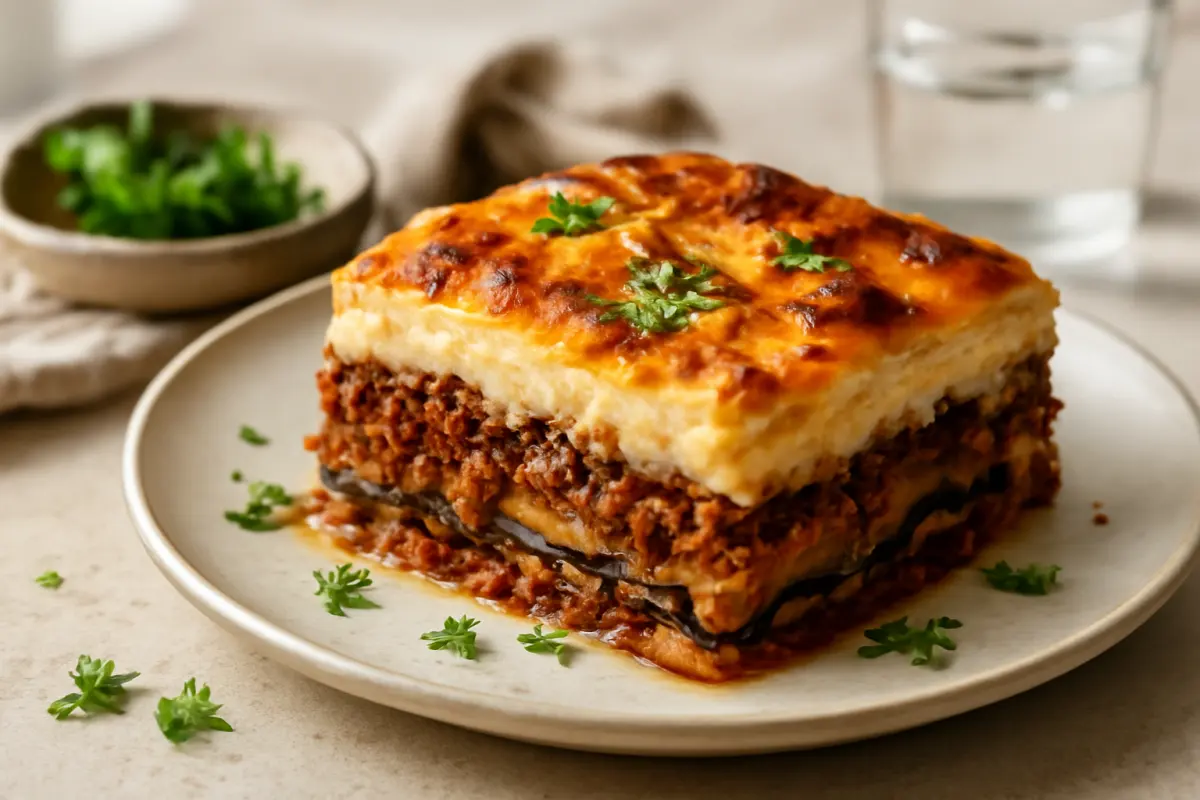
This Greek moussaka layers tender roasted eggplant and potatoes with a warmly spiced beef filling, then finishes with a thick, golden béchamel. The components can be prepared ahead, making the casserole easier to assemble and slice.
Overview
This Greek moussaka recipe makes a deeply savory, layered casserole for six to eight people. Roasting the eggplant and potatoes gives them tender centers without the splatter of deep-frying, while cinnamon, oregano, and a little allspice give the meat sauce its characteristic warmth.
The finished moussaka needs time to rest before slicing. That pause lets the béchamel set and helps the layers hold together instead of spreading across the plate.
Ingredients
- 3 medium eggplants, about 2 1/2 pounds (1.1 kg) total
- 1 pound (450 g) Yukon Gold or russet potatoes, peeled
- 5 tablespoons olive oil, divided, plus more for the pans
- 1 medium yellow onion, finely diced
- 3 garlic cloves, finely chopped
- 1 pound (450 g) ground beef or ground lamb
- 1 can (14 ounces/400 g) crushed tomatoes
- 2 tablespoons tomato paste
- 1/2 cup (120 ml) dry red wine or water
- 1 teaspoon dried oregano
- 1/2 teaspoon ground cinnamon
- 1/4 teaspoon ground allspice
- 1 teaspoon kosher salt for the sauce, plus more for seasoning
- 1/2 teaspoon freshly ground black pepper
- 2 tablespoons chopped fresh parsley
- 4 tablespoons unsalted butter
- 1/4 cup (30 g) all-purpose flour
- 3 cups (720 ml) whole milk, warmed
- 1 large egg yolk
- 1/2 cup (45 g) finely grated Parmesan, divided
- 1/4 teaspoon ground nutmeg
How to make it
Heat the oven and prepare the vegetables. Heat the oven to 425°F (220°C). Lightly oil two large rimmed baking sheets. Trim the eggplants and cut them lengthwise into slices about 1/3 inch (8 mm) thick. Cut the potatoes into slices about 1/4 inch (6 mm) thick. Arrange the vegetables in a single layer on the baking sheets, brush both sides with 3 tablespoons of the olive oil, and season lightly with salt and pepper.
Roast the eggplant and potatoes. Roast the potatoes for 20 to 25 minutes, turning once, until tender when pierced and lightly golden at the edges. Roast the eggplant for 25 to 30 minutes, turning once, until soft and flexible with browned patches. If the pans are crowded, use a third pan; overlapping vegetables will steam rather than brown. Set the roasted vegetables aside and reduce the oven to 375°F (190°C).
Make the meat sauce. Warm the remaining 2 tablespoons olive oil in a large skillet or Dutch oven over medium heat. Add the onion and cook for 6 to 8 minutes, stirring occasionally, until soft and translucent. Add the garlic and cook for 30 seconds.
Add the ground beef or lamb. Cook for 7 to 10 minutes, breaking it into small pieces, until no pink remains and any released liquid has cooked away. Stir in the tomato paste, oregano, cinnamon, allspice, 1 teaspoon salt, and pepper. Cook for 1 minute, until the tomato paste darkens slightly.
Pour in the wine or water and scrape up any browned bits from the pan. Add the crushed tomatoes. Bring the sauce to a gentle simmer, then cook uncovered for 25 to 30 minutes, stirring occasionally. It should be thick enough that a spoon dragged across the pan leaves a trail for a moment, with very little watery liquid around the meat. Stir in the parsley and remove from the heat.
Make the béchamel. Melt the butter in a medium saucepan over medium heat. Whisk in the flour and cook for 1 minute, until the mixture is smooth and lightly foamy but not brown. Gradually whisk in the warm milk, adding it in a slow stream to prevent lumps. Cook for 6 to 8 minutes, whisking often, until the sauce is thick enough to coat a spoon.
Remove the saucepan from the heat. In a small bowl, whisk the egg yolk with 2 tablespoons of the hot béchamel. Whisk that mixture back into the saucepan. Stir in the nutmeg and 1/4 cup (25 g) Parmesan. Taste and adjust the salt. The béchamel should be thick but spreadable; if it becomes too stiff, whisk in 1 to 2 tablespoons of milk.
Assemble the moussaka. Lightly oil a 9-by-13-inch (23-by-33-cm) baking dish. Arrange the potatoes in an even layer on the bottom. Add half of the eggplant, then spread all of the meat sauce over it. Add the remaining eggplant and spoon the béchamel over the top, spreading it to the edges. Sprinkle with the remaining 1/4 cup (20 g) Parmesan.
Bake and rest. Bake at 375°F (190°C) for 40 to 45 minutes, until the top is puffed and golden and the sauce is bubbling at the edges. If the top is still pale, place the dish under the broiler for 1 to 2 minutes, watching closely. Rest the moussaka for at least 30 minutes before cutting. The center should feel set rather than fluid when gently pressed, and the first slice should hold distinct layers.
Expert tips
- For a less watery casserole, cook the meat sauce until it is thick before assembling. A loose sauce can make the moussaka difficult to slice.
- Eggplant size varies. If the slices do not fit in a single layer, roast them in batches rather than stacking them.
- Ground lamb gives a richer, more traditional flavor; ground beef is milder and works well in the same quantity. A 50-50 mixture is also suitable.
- To prepare ahead, roast the vegetables and cook the meat sauce up to 2 days in advance. Refrigerate them separately, then make the béchamel and assemble when ready to bake.
- If using cold components from the refrigerator, add about 10 to 15 minutes to the covered baking time, then uncover and bake until the top is golden. Do not put a cold glass baking dish into a hot oven unless the dish is specifically rated for that use.
- If the béchamel forms lumps, whisk it vigorously while warm or pass it through a fine sieve before adding the egg yolk.
Serving and storage
Serve the moussaka warm or at room temperature with a crisp green salad or simply dressed vegetables. Cutting it too soon will make the layers slide, so keep the full resting time even if the top looks ready.
Refrigerate leftovers in a covered container within 2 hours of cooking and use them within 3 to 4 days. Reheat individual portions in a 350°F (175°C) oven until hot throughout, or microwave them in short intervals. The assembled, unbaked casserole can be refrigerated for up to 24 hours; bake it until the center is hot and the top is browned.
Frequently asked questions
Can I make Greek moussaka ahead of time?
Yes. Roast the vegetables and cook the meat sauce up to 2 days ahead, then refrigerate them separately. Assemble with freshly made béchamel and bake. You can also assemble the casserole up to 24 hours ahead and keep it refrigerated before baking.
Why is my moussaka watery?
The usual causes are under-reduced meat sauce, crowded vegetables that steamed instead of roasted, or cutting the casserole before it rested. Cook the meat sauce until thick, roast the vegetables in a single layer, and rest the baked moussaka for at least 30 minutes.
Can I use ground beef instead of lamb?
Yes. Replace the lamb with the same quantity of ground beef. Beef gives the filling a slightly milder flavor, while lamb makes it richer. A combination of both also works.
Do I have to salt eggplant before roasting?
No. Modern eggplant is usually mild, and roasting it directly is convenient for this casserole. If your eggplant seems particularly bitter, salt the slices lightly, leave them for 20 minutes, pat them dry, and then oil and roast them.
How do I know when moussaka is done?
The béchamel should be puffed and golden, the edges should bubble, and the center should feel set rather than slosh when the dish is gently moved. Rest it before slicing so the layers firm up.