Recipes
Pistachio Baklava Recipe
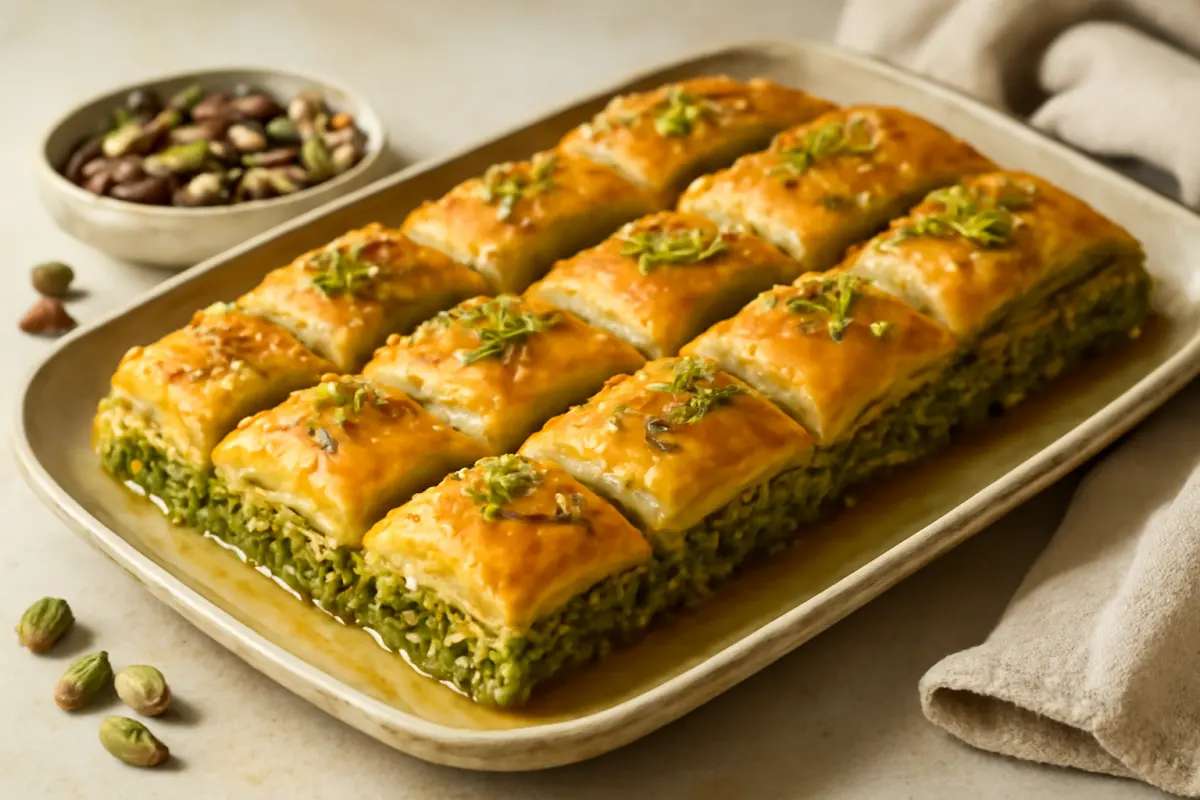
This pistachio baklava has crisp, golden phyllo, finely chopped pistachios, and a bright lemon-honey syrup that soaks into every layer without making the pastry soggy.
Overview
This pistachio baklava recipe makes a crisp, richly buttery pastry in a 9-by-13-inch pan. The filling uses finely chopped pistachios with a little cinnamon, while a lemon-honey syrup adds sweetness and keeps the layers tender underneath their crisp tops.
For the best texture, thaw the phyllo slowly in the refrigerator, keep it covered while assembling, and pour cooled syrup over the baklava as soon as it comes out of the oven. Let the finished pastry rest for several hours so the syrup can distribute through the layers.
Ingredients
- 1 pound phyllo dough, thawed overnight in the refrigerator
- 1 cup unsalted butter, melted and slightly cooled
- 4 cups shelled unsalted pistachios, finely chopped, about 14 ounces
- 1 teaspoon ground cinnamon
- 1/4 teaspoon fine salt
For the syrup
- 1 1/2 cups granulated sugar
- 1 cup water
- 1/4 cup honey
- 1 tablespoon fresh lemon juice
- 1 wide strip lemon peel, removed with a vegetable peeler
- 1 teaspoon vanilla extract
How to make it
Thaw and prepare the phyllo. Thaw the unopened package in the refrigerator overnight. Let it sit at room temperature for 30 minutes before opening. Unroll the sheets and cover them with a large piece of plastic wrap topped with a barely damp kitchen towel. Keep the phyllo covered while you work so it does not dry out.
Make the syrup. Combine the sugar, water, honey, lemon juice, and lemon peel in a saucepan. Bring to a boil over medium-high heat, stirring until the sugar dissolves. Reduce the heat and simmer for 5 minutes. Remove the pan from the heat, stir in the vanilla, and discard the lemon peel. Let the syrup cool to room temperature. It should be pourable, not thick or sticky.
Prepare the filling and pan. Heat the oven to 350°F. Lightly brush a 9-by-13-inch baking pan with melted butter. Mix the chopped pistachios, cinnamon, and salt in a bowl. Keep the remaining butter nearby with a pastry brush.
Build the bottom layers. Place one sheet of phyllo in the pan and brush it lightly all over with butter. Repeat with 9 more sheets, brushing each sheet before adding the next. If a sheet wrinkles or tears, fit it into the pan as best you can; small tears will disappear into the finished layers.
Add the filling in layers. Sprinkle one-third of the pistachio mixture evenly over the phyllo. Cover with 5 more phyllo sheets, brushing each with butter. Add another one-third of the pistachios, then 5 more buttered sheets. Finish with the remaining pistachios.
Finish the top. Add the remaining phyllo sheets one at a time, brushing each with butter. Brush the final sheet thoroughly, especially around the edges. Tuck down any overhanging edges with the tip of the brush or a dull knife.
Score the baklava. Using a sharp knife, cut through the pastry into diamonds or squares before baking. For 16 large pieces, make 4 cuts lengthwise and 4 cuts crosswise. Cut all the way through the phyllo and filling, but work carefully so you do not drag the layers out of place.
Bake until deeply golden. Bake for 50 to 60 minutes, rotating the pan halfway through. The top should be evenly deep golden brown, the edges should look crisp, and the center should no longer appear pale or damp. If the top browns too quickly, loosely cover it with foil for the remaining baking time.
Add the syrup. Remove the hot baklava from the oven and immediately pour the cooled syrup slowly over the scored lines and edges. You should hear a gentle sizzle. Pour in stages so the syrup has time to run between the layers rather than pooling in one spot.
Cool and rest. Leave the baklava uncovered at room temperature for at least 4 hours, preferably overnight. The phyllo will remain crisper if it is not covered while warm. Recut the original lines before serving and lift out the pieces with a small spatula.
Expert tips
- Keep phyllo covered: A dry sheet cracks easily, while a wet towel can make it gummy. The towel should be barely damp and should sit over plastic wrap, not directly on the dough.
- Use a light layer of butter: Brush enough to cover the sheet without leaving puddles. Excess butter can make the bottom greasy.
- Chop the pistachios finely but not into a paste: Small, even pieces distribute well and give the filling a pleasant texture.
- Do not skip scoring: Cutting after baking can shatter the crisp top and compress the layers.
- If the center seems soft after 50 minutes: Continue baking in 5-minute increments. Baklava should be richly golden across the center, not merely browned at the edges.
- If using salted pistachios: Omit the added salt and expect a slightly saltier filling. Avoid roasted pistachios with strong seasoning.
- For a less sweet pastry: Reduce the syrup sugar to 1 1/4 cups, but keep the water and honey amounts the same. The finished baklava will be less saturated and slightly less glossy.
Serving and storage
Serve the baklava at room temperature with coffee, tea, or a glass of cold milk. The flavor and texture are usually best after resting overnight.
Store the uncovered baklava in the pan at room temperature for up to 5 days, loosely covered only after it has cooled completely. Refrigeration can soften the phyllo, but leftovers may be refrigerated in an airtight container for up to 1 week. Bring them to room temperature before serving. For longer storage, freeze individual pieces in a well-sealed container for up to 2 months and thaw them uncovered at room temperature.
Frequently asked questions
Can I use roasted pistachios for baklava?
Yes. Use unsalted roasted pistachios for a deeper, toastier flavor. If they are salted, leave the 1/4 teaspoon salt out of the filling.
Why did my baklava turn soggy?
Common causes are underbaking, pouring warm syrup over warm pastry, or covering the baklava before it has cooled. Bake until the center is deeply golden, cool the syrup completely, and leave the finished baklava uncovered while it rests.
Can I make pistachio baklava ahead of time?
Yes. Baklava is well suited to making a day ahead. Let it rest overnight at room temperature so the syrup settles through the layers while the top stays crisp.
How do I stop phyllo dough from tearing?
Thaw it fully, keep unused sheets covered, and brush gently rather than dragging the brush across the dough. A torn sheet can still be used; place it in the pan and continue layering.
Can I freeze pistachio baklava?
Yes. Freeze completely cooled pieces in an airtight container with parchment between layers for up to 2 months. Thaw them uncovered at room temperature to reduce condensation on the phyllo.