Recipes
Turkish Pide Recipe
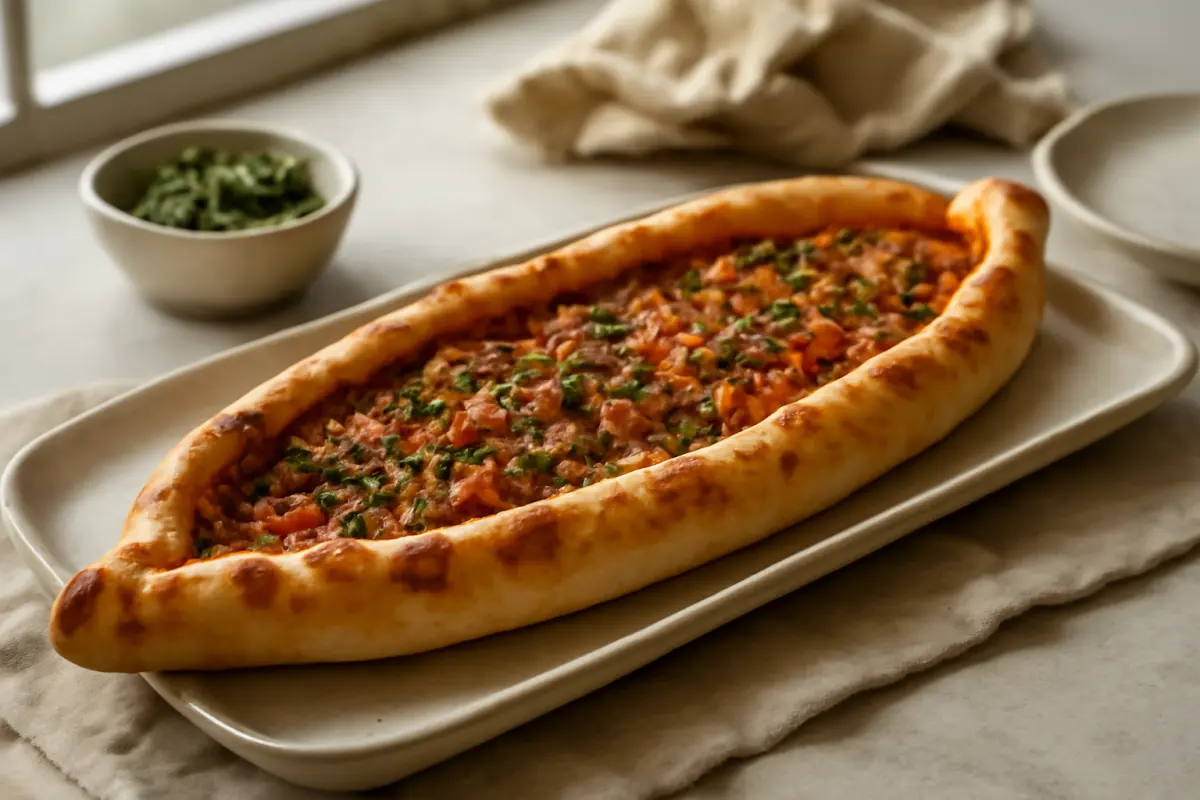
This Turkish pide recipe makes four boat-shaped flatbreads with a crisp edge, chewy center, and richly seasoned ground beef topping. A hot oven and a thin layer of filling help the dough cook evenly while the edges brown.
Overview
This Turkish pide recipe makes four individual kıymalı pide: boat-shaped flatbreads topped with seasoned ground beef, onion, pepper, tomato, and parsley. The dough bakes up chewy in the middle with crisp, browned edges.
For the best texture, heat the oven and baking surface thoroughly before you begin shaping. Keep the topping finely chopped and spread it in a thin, even layer so the dough cooks before the filling releases too much moisture.
Ingredients
- 500 g (4 cups plus 2 tablespoons) bread flour, plus extra for shaping
- 7 g (2 1/4 teaspoons) instant yeast
- 10 g (1 3/4 teaspoons) fine salt
- 15 g (1 tablespoon) olive oil, plus more for brushing
- 325 g (1 1/3 cups plus 1 tablespoon) lukewarm water, approximately 100–110°F (38–43°C)
- 300 g (10 1/2 ounces) ground beef, preferably 15–20% fat
- 1 small yellow onion, about 150 g, very finely minced
- 1 medium green bell pepper, about 120 g, very finely minced
- 1 medium ripe tomato, about 150 g, grated on the large holes of a box grater; discard the skin
- 2 garlic cloves, finely grated
- 1 tablespoon tomato paste
- 1 teaspoon sweet paprika
- 1/2 teaspoon ground cumin
- 1/2 teaspoon fine salt
- 1/4 teaspoon freshly ground black pepper
- 3 tablespoons finely chopped flat-leaf parsley
- 1 egg, beaten, for brushing the crust
- 1 tablespoon melted butter, for finishing
- Lemon wedges, for serving
How to make it
Mix the dough. Put the flour, yeast, and salt in a large bowl. Add the olive oil and lukewarm water. Stir with a wooden spoon until a shaggy dough forms, then knead by hand for 8–10 minutes. The dough should become smooth, elastic, and slightly tacky but not wet. If it feels stiff, knead in water 1 teaspoon at a time; if it is very sticky, add flour 1 tablespoon at a time.
Let the dough rise. Shape the dough into a ball and place it in a lightly oiled bowl. Cover and leave at room temperature for 60–90 minutes, until doubled in size. In a cool kitchen, this may take closer to 2 hours.
Prepare the topping. While the dough rises, combine the ground beef, minced onion, bell pepper, grated tomato, garlic, tomato paste, paprika, cumin, salt, pepper, and parsley. Mix until evenly combined. The mixture should be moist but not watery. If the tomato released a lot of liquid, lift out some of the excess with a spoon rather than adding flour or breadcrumbs.
Heat the oven and baking surface. Put a baking steel, pizza stone, or heavy baking sheet on the lowest oven rack. Heat the oven to its highest setting, ideally 500°F (260°C), for at least 45 minutes. If your oven reaches only 475°F (245°C), allow at least 15–20 minutes of additional preheating.
Divide the dough. Turn the risen dough onto a lightly floured surface and divide it into four equal pieces, about 215 g each. Shape each piece into a smooth ball. Cover the balls with a clean towel and let them rest for 15 minutes. This short rest relaxes the dough and makes it easier to stretch.
Shape the first pide. Work with one dough ball at a time, keeping the others covered. Roll or stretch it into an oval about 12 inches long and 5 inches wide. Transfer it to a sheet of parchment if that makes it easier to move. Spread one-quarter of the topping over the dough, leaving about 1/2 inch uncovered around the edge. Press the filling into a thin, even layer.
Form the boat shape. Fold the uncovered dough edge inward slightly along both long sides. Pinch the pointed ends firmly, then pull the ends outward a little to create the characteristic boat shape. Brush the exposed rim with beaten egg. Do not let the topping pile up in the center; a thin layer cooks more evenly.
Bake. Slide the pide, parchment and all, onto the hot baking surface. Bake for 8–12 minutes, depending on your oven, until the crust is puffed and deeply golden at the edges and the meat is fully cooked with no pink center. If the top browns before the base looks set, move the pide to a higher rack for the final 2 minutes. Bake the remaining pide one at a time, or two at a time if your baking surface is large enough without crowding.
Finish and serve. Brush the hot crust with melted butter. Rest the pide for 2–3 minutes, then slice it crosswise or cut it into strips. Serve hot with lemon wedges.
Expert tips
- Use a hot surface: A preheated steel or stone gives the bottom a firmer, crisper finish. A heavy overturned baking sheet is a practical substitute.
- Keep the topping fine: Large pieces of onion or pepper can prevent the filling from lying flat and may leave the crust undercooked beneath them.
- Avoid excess tomato liquid: Watery topping can make the center soggy. Grate the tomato, discard the skin, and spoon off extra liquid if needed.
- If the dough keeps shrinking: Cover it and let it rest for another 10 minutes before stretching. The gluten will relax and the oval will hold its shape more easily.
- For a cheese version: Replace the meat topping with about 300 g grated mozzarella or Turkish kaşar, adding it after shaping. Bake until the cheese is melted and the crust is browned.
- For lamb: Substitute ground lamb for the beef, or use half beef and half lamb. The same baking cues apply.
Serving and storage
Serve pide immediately while the crust is warm and the edges are crisp. Lemon wedges, sliced red onion, parsley, or a simple tomato-and-cucumber salad pair well with the savory topping.
Cool leftovers within 2 hours, place them in an airtight container, and refrigerate for up to 3 days. Reheat on a baking sheet at 375°F (190°C) for 8–10 minutes, until hot throughout and the crust has regained some crispness. You can freeze fully baked, cooled pide for up to 2 months; wrap individual pieces tightly and reheat from thawed or frozen until steaming hot.
Frequently asked questions
Can I make Turkish pide without a pizza stone?
Yes. Preheat a heavy baking sheet upside down on the lowest oven rack for at least 45 minutes. The surface will not hold heat quite like a stone or steel, so bake one pide at a time and expect the base to need an extra minute or two.
Why is the middle of my pide soggy?
The topping was probably too wet or too thick, or the baking surface was not fully preheated. Spoon off excess tomato liquid, spread the filling thinly, and heat the oven and baking sheet thoroughly before baking.
Can I prepare the dough ahead of time?
Yes. After kneading, cover the dough and refrigerate it for up to 24 hours. Let it sit at room temperature for about 60 minutes before dividing and shaping so it becomes easier to stretch.
How do I know when the meat topping is done?
The filling should be browned in places, bubbling, and completely opaque with no pink patches. If checking with a thermometer, ground meat should reach 160°F (71°C) in the center.