Recipes
Lasagna Recipe
This lasagna layers rich beef-tomato sauce, creamy béchamel, tender pasta, mozzarella, and Parmesan. Rest it before slicing for neat layers and a saucy, satisfying finish.
Overview
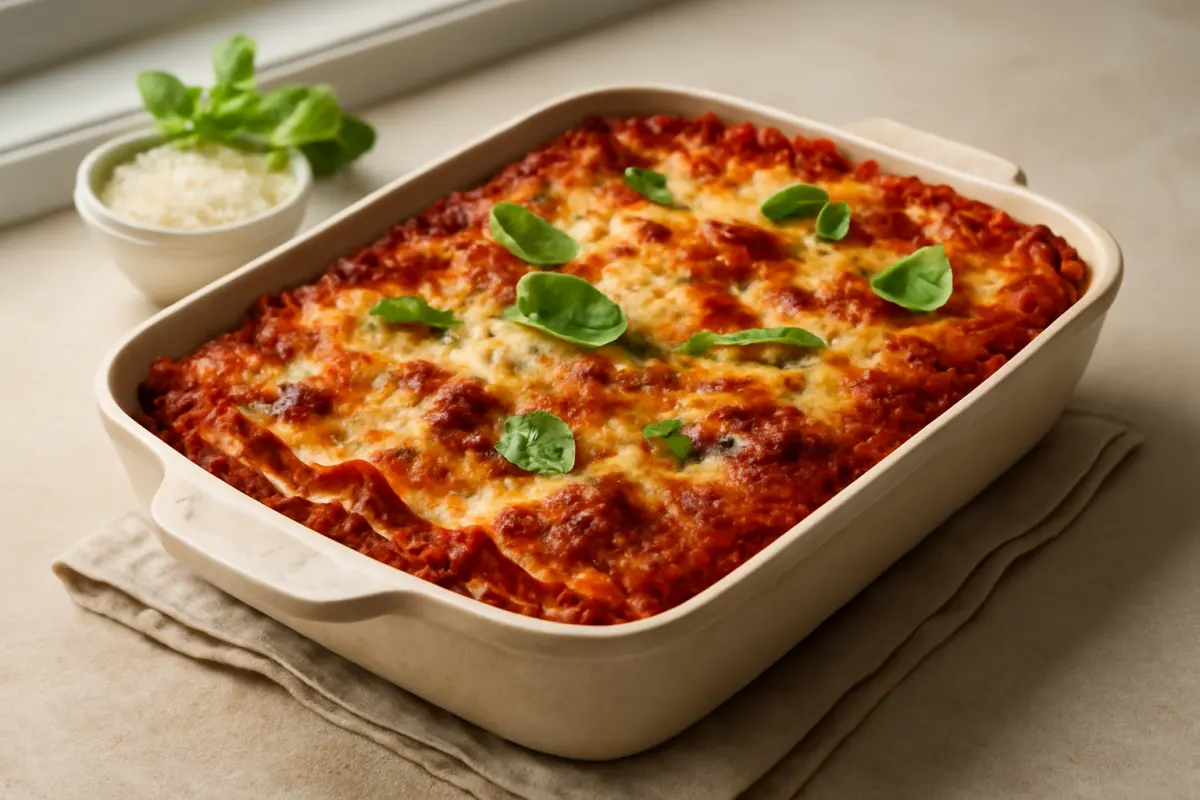
This lasagna recipe makes a deep, comforting bake with three distinct layers: a gently simmered beef-tomato sauce, a smooth white sauce, and pasta sheets held together with mozzarella and Parmesan. The sauce is seasoned simply so the beef, tomato, cheese, and herbs remain balanced.
Use a 9-by-13-inch (23-by-33-centimeter) baking dish for eight generous portions. The lasagna is ready when the edges are bubbling, the cheese is browned in spots, and a knife slides easily through the pasta. Let it rest before cutting so the layers have time to settle.
Ingredients
- 2 tablespoons olive oil
- 1 medium yellow onion, finely diced
- 1 medium carrot, finely diced
- 1 celery stalk, finely diced
- 4 garlic cloves, minced
- 1 pound (450 g) ground beef
- 1 teaspoon fine salt, divided, plus more for the pasta water
- 1/2 teaspoon black pepper
- 1 teaspoon dried oregano
- 1/2 teaspoon dried basil
- 2 tablespoons tomato paste
- 1 can (28 ounces/794 g) crushed tomatoes
- 1 cup (240 ml) water or unsalted beef stock
- 1 bay leaf
- 12 dried lasagna sheets, about 12 ounces (340 g), preferably oven-ready
- 5 tablespoons unsalted butter
- 5 tablespoons all-purpose flour
- 3 cups (720 ml) whole milk, warmed
- 1/4 teaspoon ground nutmeg
- 1/2 teaspoon fine salt for the béchamel
- 1 1/2 cups (150 g) shredded low-moisture mozzarella
- 1 cup (100 g) finely grated Parmesan, divided
- Chopped fresh parsley, optional, for serving
How to make it
Cook the beef sauce. Heat the olive oil in a large, heavy saucepan over medium heat. Add the onion, carrot, and celery with 1/4 teaspoon of the salt. Cook for 7 to 9 minutes, stirring occasionally, until the vegetables are soft and the onion looks translucent. Add the garlic and cook for 30 seconds.
Add the ground beef and break it into small pieces with a wooden spoon. Cook for 8 to 10 minutes, stirring, until no pink remains and some of the meat has developed browned edges. If there is a large amount of rendered fat, spoon off most of it, leaving enough to keep the sauce moist.
Stir in the pepper, oregano, basil, and tomato paste. Cook for 1 minute, stirring constantly, until the paste darkens slightly. Add the crushed tomatoes, water or stock, bay leaf, and the remaining 3/4 teaspoon salt. Bring the sauce to a gentle simmer.
Partly cover the pan and simmer for 30 to 35 minutes, stirring every few minutes. The finished sauce should be thick enough that a spoon dragged across the bottom leaves a path for a moment, but it should still look loose enough to spread. Remove the bay leaf and taste for seasoning.
Make the béchamel. Melt the butter in a medium saucepan over medium heat. Whisk in the flour and cook for 1 1/2 to 2 minutes; the mixture should look smooth and lightly foamy, not brown. Gradually whisk in the warm milk, adding it in small splashes at first to prevent lumps.
Bring the béchamel to a gentle simmer and cook for 5 to 7 minutes, whisking often. It is ready when it coats the back of a spoon and a finger drawn through it leaves a clear line. Stir in the nutmeg and 1/2 teaspoon salt. If small lumps remain, pass the sauce through a fine sieve while it is hot.
Prepare the oven and pasta. Heat the oven to 375°F (190°C). If using regular dried lasagna sheets rather than oven-ready sheets, boil them in well-salted water according to the package directions until flexible but still slightly firm. Drain and lay them flat on a lightly oiled tray or clean kitchen towel. Oven-ready sheets can be used dry.
Assemble the lasagna. Spread about 1 cup of beef sauce over the base of the baking dish. Add a layer of pasta, trimming sheets if needed. Spread over one-quarter of the remaining beef sauce, then one-quarter of the béchamel. Sprinkle with about 1/4 cup mozzarella and 2 tablespoons Parmesan. Repeat these layers three more times, finishing with béchamel, the remaining mozzarella, and the remaining Parmesan.
Cover the dish tightly with foil, keeping the foil from touching the cheese if possible. Bake for 25 minutes. Remove the foil and bake for another 20 to 25 minutes, until the edges are bubbling and the top is golden brown in spots. If the top needs more color, place the dish under the broiler for 1 to 2 minutes, watching closely.
Let the lasagna rest uncovered for 20 to 30 minutes before slicing. Cut into eight portions with a sharp knife, then lift each piece with a wide spatula. Sprinkle with parsley if using.
Expert tips
- For firm, sliceable layers: Do not skip the resting time. Cutting immediately after baking usually makes the sauce run out before the layers have set.
- If the sauce looks watery: Simmer it uncovered for 5 to 10 minutes longer before assembling. Excess liquid can make the lasagna slide apart.
- If the lasagna seems dry: Check that the pasta is fully covered with sauce, especially at the corners. Oven-ready sheets need enough moisture to soften as they bake.
- If the top browns too quickly: Keep the foil on for most of the baking time, then uncover only for the final 10 to 15 minutes.
- Realistic substitutions: Ground pork can replace up to half of the beef. Whole-milk ricotta can replace the béchamel, using about 3 cups seasoned with 1 egg, 1/2 teaspoon salt, and 1/4 teaspoon pepper, but the finished texture will be softer and less creamy.
- For make-ahead cooking: Assemble the lasagna, cover it, and refrigerate it for up to 24 hours. Let it sit at room temperature for 20 minutes while the oven heats, then add about 10 minutes to the covered baking time.
Serving and storage
Serve the lasagna with a simple green salad or steamed vegetables to balance the rich, layered bake. Allow leftovers to cool in the baking dish for no more than 2 hours before refrigerating them in a covered container.
Refrigerate leftovers for up to 4 days. Reheat individual portions in the microwave until steaming hot throughout, or cover a larger portion with foil and warm it in a 350°F (175°C) oven until hot in the center. You can freeze cooled portions in airtight containers for up to 3 months; thaw them in the refrigerator before reheating.
Frequently asked questions
Can I assemble lasagna the day before baking?
Yes. Assemble it in a covered baking dish and refrigerate it for up to 24 hours. Bake it straight from the refrigerator after letting it sit out for about 20 minutes, and add roughly 10 minutes to the covered baking time.
Do I need to boil oven-ready lasagna sheets?
No. Use oven-ready sheets dry, but make sure every sheet is covered with sauce or béchamel. They soften from the moisture released during baking.
Why does my lasagna fall apart when I slice it?
It may have too much liquid, or it may have been cut while still piping hot. Simmer the beef sauce until thick, cover the pasta completely, and rest the baked lasagna for 20 to 30 minutes before slicing.
Can I use ricotta instead of béchamel?
Yes. Replace the béchamel with about 3 cups whole-milk ricotta mixed with 1 egg, 1/2 teaspoon salt, and 1/4 teaspoon black pepper. The lasagna will have a thicker, slightly grainier filling rather than a smooth white sauce.