Desserts
Suji Halwa Recipe
This suji halwa recipe makes a soft, glossy semolina pudding with deeply roasted suji, fragrant cardamom, ghee, and toasted nuts. The method explains how to add the hot liquid safely and cook the halwa until smooth rather than grainy or watery.
Overview
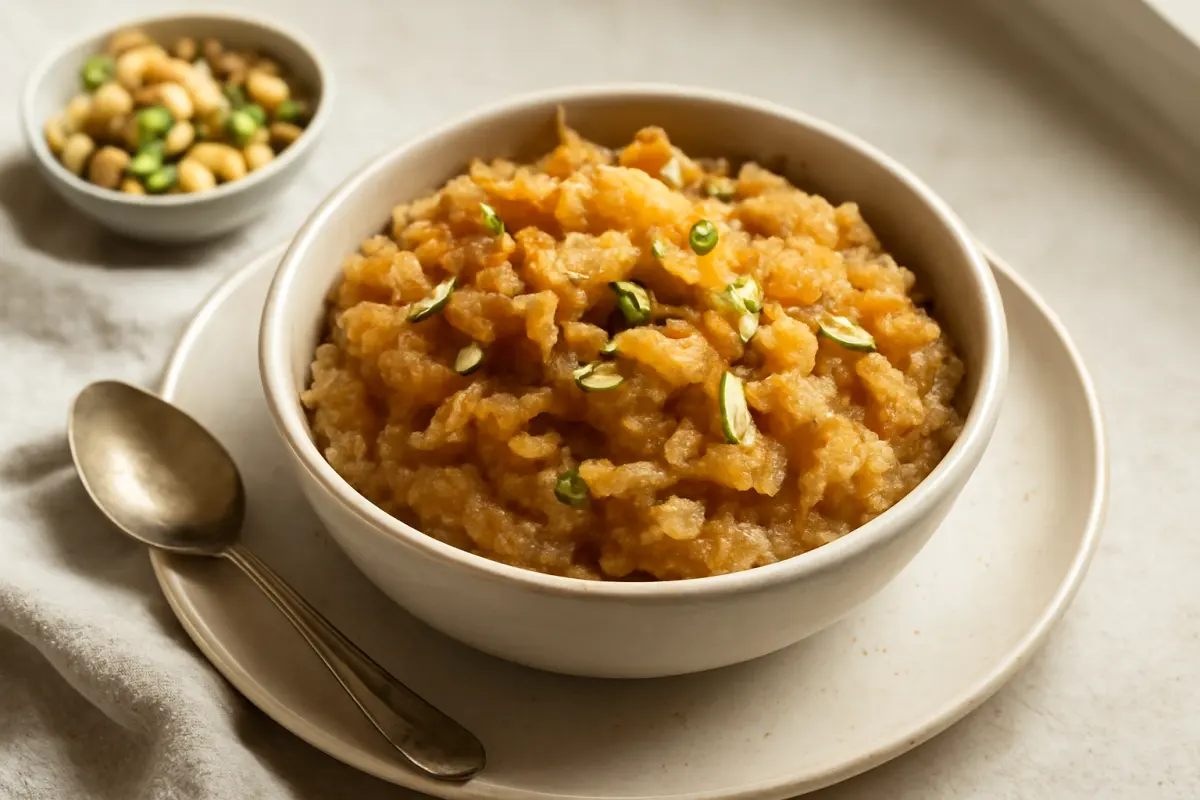
This suji halwa is a soft Indian semolina pudding made by slowly roasting suji in ghee before adding sweetened water. The roasting step gives the halwa its warm, nutty aroma and keeps the finished texture pleasantly fluffy instead of floury.
The recipe makes about 4 to 6 servings and takes roughly 30 minutes. Use medium-grain semolina if possible, and keep the heat moderate while roasting so the suji colors evenly without turning bitter.
Ingredients
- 1 cup (170 g) fine or medium semolina, also called suji or sooji
- 1/2 cup (115 g) ghee, plus 1 teaspoon for greasing if serving from a mold
- 3/4 cup (150 g) granulated sugar
- 2 1/2 cups (600 ml) water
- 4 green cardamom pods, lightly crushed, or 1/2 teaspoon ground cardamom
- 2 tablespoons raisins
- 2 tablespoons sliced or slivered almonds
- 2 tablespoons chopped cashews
- 1 small pinch of salt
How to make it
Prepare the sweetened water. Put the water, sugar, crushed cardamom pods, and salt in a saucepan. Bring it to a gentle boil over medium heat, stirring once or twice until the sugar dissolves. Reduce the heat to low and keep the mixture hot. If using ground cardamom, add it later with the roasted semolina instead.
Warm the ghee. Heat the ghee in a heavy-bottomed, wide saucepan or deep skillet over medium-low heat. Add the raisins, almonds, and cashews. Stir for 1 to 2 minutes, until the nuts are lightly golden and the raisins begin to plump. Transfer them to a small bowl, leaving the ghee in the pan.
Roast the semolina. Add the semolina to the hot ghee. Stir continuously with a wooden spoon or heatproof spatula, scraping across the bottom and into the corners. Roast for 8 to 12 minutes over medium-low heat.
The suji is ready when it smells distinctly nutty, the grains feel loose and sandy, and the color has changed from pale cream to a light golden beige. Do not wait for it to become dark brown; it will continue cooking when the liquid is added. If the semolina starts browning in patches or sticking, lower the heat immediately.
Add the hot liquid carefully. Move the pan off the heat for a few seconds. Slowly pour in about one-quarter of the hot sweetened water while stirring constantly. It will bubble and release steam, so keep your hand and face away from the pan. Once the liquid is absorbed, add the remaining water in two or three additions, stirring continuously to break up lumps.
Cook until thick and glossy. Return the pan to low heat. Stir for 3 to 6 minutes, pressing out any lumps against the side of the pan. At first the mixture will look loose and grainy; it is ready when the semolina has swollen, the halwa pulls away from the sides, and a spoon dragged across the bottom leaves a path that stays open for a moment. The texture should be soft and spoonable, not dry or crumbly.
Finish the halwa. Stir in the toasted nuts and raisins. If using ground cardamom, add it now. Taste carefully once the mixture has cooled slightly and add a pinch more sugar or cardamom only if needed.
Serve. Spoon the halwa into bowls and serve hot or warm. For a molded presentation, lightly grease a small bowl with ghee, pack in the warm halwa, and turn it onto a plate after 1 to 2 minutes. Scatter with a few extra nuts if desired.
Expert tips
- For a smoother texture: Use fine semolina and add the hot liquid slowly while stirring. Pouring it in all at once makes stubborn lumps more likely.
- For richer halwa: Replace up to 2 tablespoons of the water with milk, but keep the mixture refrigerated if any leftovers contain milk.
- For less sweetness: Reduce the sugar to 1/2 cup for a mildly sweet halwa. Do not reduce the liquid at the same time.
- If the halwa is too thick: Stir in 2 to 4 tablespoons of hot water, one tablespoon at a time, over low heat until it loosens.
- If it is too loose: Cook uncovered over low heat for a few more minutes, stirring often. The semolina will continue absorbing liquid as it rests.
- If it tastes raw: Return it to low heat with 1 to 2 tablespoons of hot water and cook until the grains are tender. Raw flavor usually means the liquid was added before the semolina had finished roasting.
- If it is lumpy: Press the lumps against the side of the pan with the back of a spoon. For severe lumps, whisk the halwa briefly over low heat, taking care not to splash the hot mixture.
- If the ghee separates: This is not necessarily a problem; a little separation can happen as the halwa rests. Stir it back in before serving. Excess separation usually means the mixture needs a few more minutes of cooking and stirring.
Serving and storage
Serve suji halwa warm for the softest texture. It is especially good alongside puri, or as a simple dessert after a meal. A chilled glass of sweet lassi also works well if you want a cool accompaniment.
Cool leftovers promptly, transfer them to a covered container, and refrigerate for up to 3 days. Reheat gently in a saucepan or microwave with 1 to 2 tablespoons of water per serving, stirring until soft and hot throughout. Do not leave cooked halwa at room temperature for more than 2 hours, or more than 1 hour in a very hot room.
Frequently asked questions
Can I make suji halwa without ghee?
You can replace the ghee with an equal amount of unsalted butter or a neutral cooking oil, although the flavor and aroma will be different. Ghee gives the most traditional rich, nutty result.
Why is my suji halwa lumpy?
Lumps usually form when the liquid is added too quickly or the semolina is not stirred continuously. Keep the sweetened water hot, pour it in gradually, and stir around the edges and across the bottom of the pan.
Can I use milk instead of water?
Yes. Replace up to half of the water with milk for a creamier halwa. Add the milk to the saucepan with the water and heat it until steaming before combining it with the roasted semolina.
How do I know when the semolina is properly roasted?
It should smell nutty, look evenly light golden, and move loosely through the melted ghee. If it still smells floury, continue roasting over medium-low heat; if it darkens quickly, lower the heat.
Can I make suji halwa ahead of time?
Yes. Make it up to 3 days ahead and refrigerate it in a covered container. Reheat it gently with a little water because the halwa firms as it cools.